I build the financial data systems businesses actually make decisions on.

Finance-trained data engineer in Adelaide. I sit between the accounting and the engineering — turning messy operational systems into governed, audit-ready financial intelligence. Most finance people don't build the pipelines. Most engineers don't understand the accruals. I do both, in production.

Download CV (PDF)
  • Financial Analyst at D&S Resources
  • Master of Professional Accounting
  • CA ANZ Provisional Member
  • IBM Data Engineering Certified
Daniel Tran, Financial Analyst and data engineer, Adelaide
18 governed datasets built & maintained
5 business systems integrated into one platform
260h of manual work removed per year by automation
16 data-engineering courses certified (IBM)

About

A finance brain with engineering hands

Daniel Tran at his desk at D&S Resources, dual monitors and the Adelaide city skyline behind him
At my desk — D&S Resources, Adelaide

I'm Daniel Tran, a Financial Analyst and data engineer in Adelaide. I trained as an accountant — a Bachelor's in Vietnam, then a Master of Professional Accounting (Advanced) here in Australia — and then went and learned to build the systems accounting depends on.

The Master's went well: a GPA of 6.5 out of 7, with ten of sixteen subjects at High Distinction. Well enough that Torrens brought me back to teach one of them. As Assistant Learning Facilitator for Advanced Financial Reporting I built the lectures and worked examples, and taught classes of ten to fifteen students. My teaching was formally observed.

“You are giving excellent and clear instructions. Very calm and structured. Great contextualised examples as well.”

Teaching observation — Torrens University Australia, September 2023

The whole point

When an API call fails silently, an accountant sees a clean report and an engineer sees a green log. I see a misstated P&L. Knowing which numbers matter, and why a wrong one is dangerous, is what makes a data platform trustworthy rather than merely impressive.

The foundation

  • 6.5Master's GPA
    out of 7.0
  • 10High Distinctions
    from 16 subjects
  • 16IBM data-engineering
    courses certified

A Bachelor of Financial Accounting (RMIT University Vietnam) and a Master of Professional Accounting (Advanced) from Torrens University Australia. I'm a provisional member of Chartered Accountants Australia and New Zealand (CAANZ).

Before the data work, I did the ordinary accounting that makes numbers trustworthy — daily bank reconciliations, supplier invoices, month-end. It's unglamorous and it's the whole point. You don't earn the right to build finance systems people rely on until you've done the reconciling by hand.

The turn

At D&S Resources I moved from Finance Officer to Financial & Data Analytics Officer to Financial Analyst inside about fifteen months. Along the way I taught myself data engineering — a sixteen-course IBM professional certificate, done around a full-time job — and built the platform the business now runs its decisions on: five operational and finance systems pulled into eighteen governed datasets, updated automatically.

The automation removes around five hours of manual data work every week — roughly 260 hours a year that used to go into exporting and cleaning numbers by hand.

In production

One source of truth from five disconnected systems

The finance platform I designed, built and now run at D&S Resources. It pulls the business's operational and finance data into a single governed warehouse that leadership's reporting reads from — built finance-first, so the numbers are right, not just present.

My role Sole designer, builder & operator
Systems unified AroFlo · Xero · Employment Hero · Clockify & more
Built with n8n · Python · SQL Server · Power BI

The context

The business runs on separate systems — job management, accounting, HR, time-tracking — that don't talk to each other. Leadership needs one honest view of jobs, costs and labour to make decisions. Getting there meant someone had to reconcile those systems by hand, every reporting cycle.

The problem

The original refresh re-pulled every record on every run — slow, wasteful, and topped up by manual exporting and cleaning in spreadsheets. Worse, when a sync failed it failed silently: an accountant sees a clean report, an engineer sees a green log — nobody sees the misstated number underneath.

How it works

1

Ask only what changed

Instead of re-pulling everything, the pipeline queries each system for records changed since the last successful run — a watermark. Extraction time drops roughly 80–90%.

2

Save raw, then route

Every raw API page is saved before anything is processed, then sorted by data type through a three-stage audit trail. If a run fails mid-way, nothing is lost.

3

Validate before trusting

Record counts are reconciled at each stage — raw equals routed equals loaded. A mismatch is a hard failure, not a warning. Silent row drops are treated as defects.

4

Load idempotently

Fifteen data zones fan out in parallel and upsert into SQL Server by primary key — delete-then-insert, so running it once or ten times gives the same result.

5

Only then, commit

The watermark advances only when the whole run succeeds. If any stage fails, the next run safely re-fetches from the last good point. The pipeline heals itself.

The architecture

Architecture diagram: source systems feed an hourly incremental pipeline (change detector, raw capture, validator, idempotent loader) and a daily full-load pipeline; both are cross-checked by an automated health check into one governed SQL warehouse that Power BI reads.
Two pipelines — a fast hourly patch and a daily full-load — each cross-checked against the other, feeding one governed warehouse that reporting reads from.

The engineering doctrine

  • Save the raw data first — always keep an audit trail.
  • Paginate everything; never assume one page is the whole answer.
  • Validate counts and fail loud — a wrong number is more dangerous than a crash.
  • Design every step to be safely re-run.
  • Never trust an API to be complete or consistent.

How I know it's right

  • Counts reconciled end to end — tens of thousands of records, matched exactly.
  • A parallel mirror database, compared by set-difference to catch silent drift.
  • An automated daily health check that emails me the moment integrity slips.
  • The new warehouse reconciled to the existing report to the dollar.
80–90% less data pulled per run once seeded
~9min full refresh, down from 25–31 minutes
260h of manual work removed per year
15 data zones loaded automatically in parallel

The result: leadership's decisions now run on data that refreshes itself, checks itself, and tells someone when it can't — instead of on a spreadsheet someone had to rebuild by hand.

What I learned building it

Reconcile with set-differences, not row counts — counts can match perfectly on stale data and hide it. Treat the boring infrastructure a pipeline depends on as a first-class part of the system, not an assumption. And build for the failure that stays green: the outage that looks fine is the one that costs you.

AI in practice

AI builds. Daniel audits.

AI is part of how I work every day — not a novelty, but a tool I point at real problems and then hold to the same standard as everything else: nothing ships until the numbers reconcile. I use it to move faster; my finance training decides what's actually correct.

AI agents in production

I run AI agents in n8n inside the live finance workflow — exception triage, document summarisation and routing work to the right place — so routine judgment calls get an automatic first pass before a human looks.

Built with AI, reviewed by me

At D&S I build with Claude and Codex as pair-engineers — data pipelines, Power BI reports, SQL, DAX and Power Query (M), and this website. AI writes the first draft; I read every line, run it, reconcile it, and own the result. The speed is real — so is the review.

An AI-augmented second brain

I built a structured knowledge base in Obsidian where AI assistants read and write across my projects, notes and decisions. I capture once; AI helps me find, connect and act on it. Same knowledge, different hands.

Judgment is the job

AI is confidently wrong often enough to be dangerous in finance. I treat its output like any external system — never trusted blind, always validated against counts, reconciliations and domain sense. The tool accelerates; the accountant decides.

Tools I work with

  • Claude
  • Codex
  • Cursor
  • ChatGPT
  • GitHub Copilot
  • Gemini
  • n8n
  • Obsidian

Credentials

Qualifications you can verify

Every claim on this site traces back to a document. Here are the headline ones — with links to verify them where the issuer provides one.

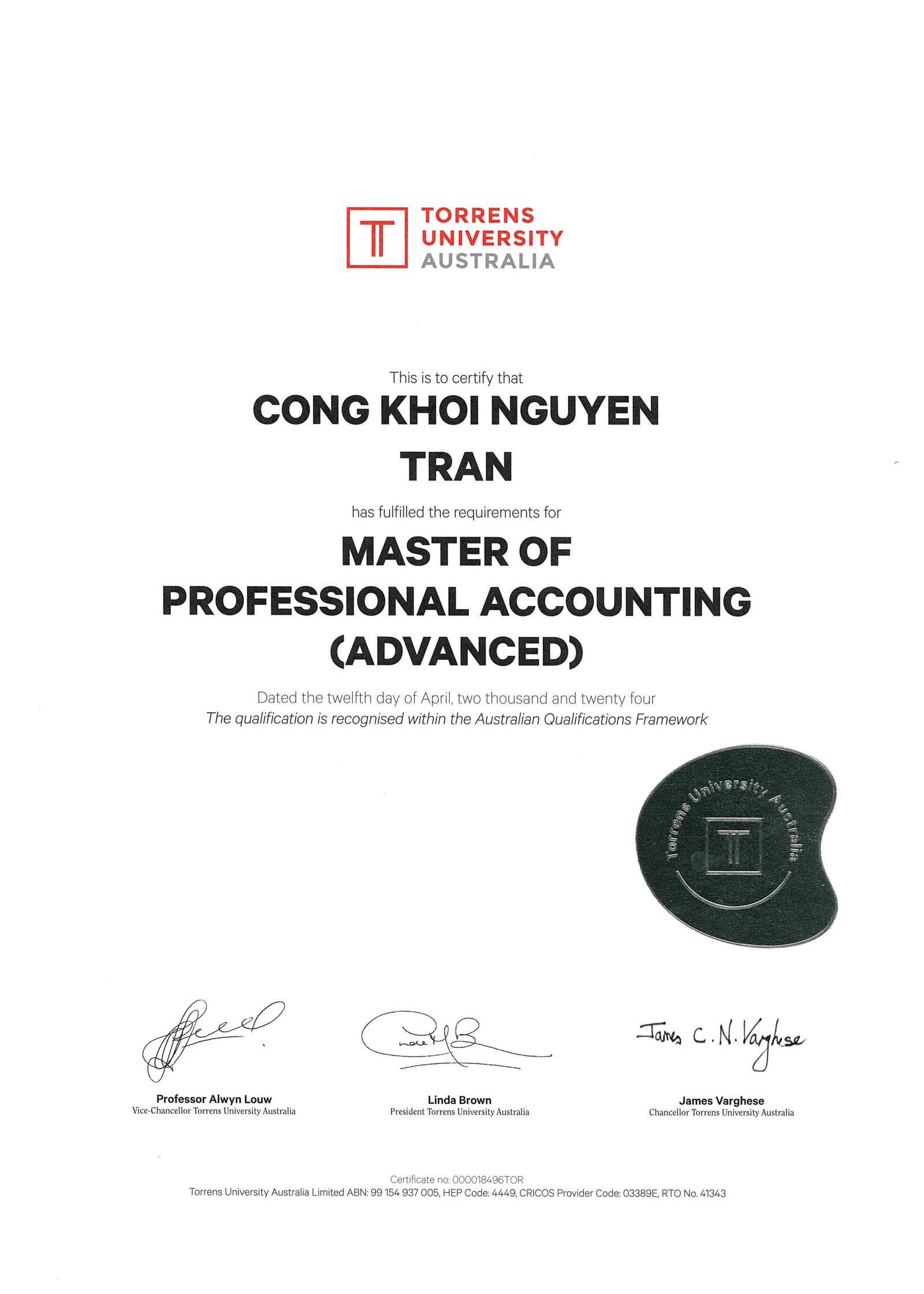
Master of Professional Accounting (Advanced)

Distinction average

Torrens University Australia · 2022–2023

GPA 6.5 / 7.0 · 10 High Distinctions from 16 subjects. Top marks: Accounting for Management Decision Making 95, Tax Laws & Practice 92.

Master of Professional Accounting (Advanced) degree certificate, Torrens University Australia

Bachelor of Financial Accounting

RMIT University Vietnam · 2013–2017

Undergraduate foundation in financial accounting.

Provisional Member, CAANZ

Chartered Accountants Australia & New Zealand

On the pathway to the Chartered Accountant (CA) designation.

Xero Advisor Certified

Xero

Certified in the Xero cloud accounting platform.

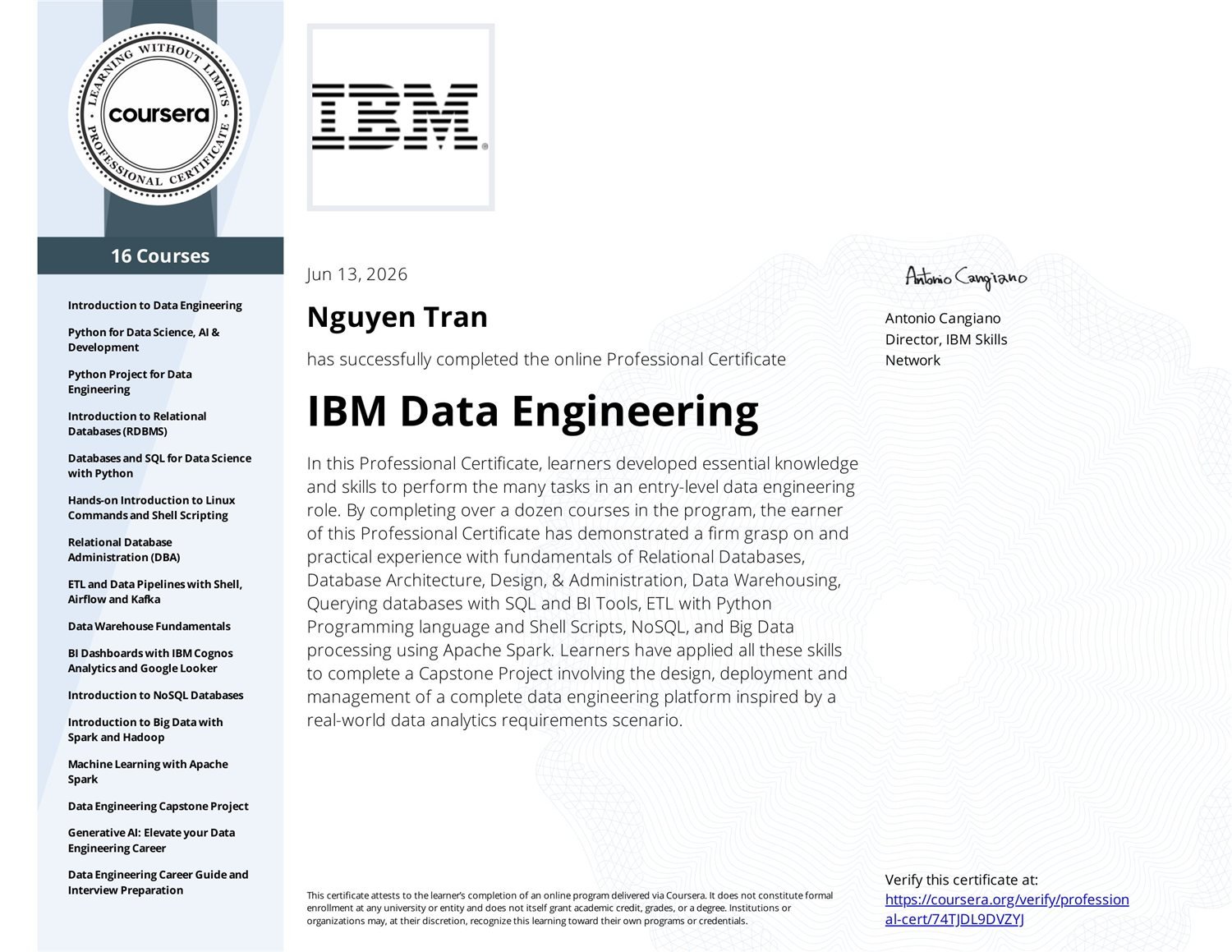
IBM Data Engineering Professional Certificate

IBM · Coursera · June 2026

A 16-course specialisation in Python, SQL, ETL, data warehousing, NoSQL and big data with Apache Spark — completed around a full-time job, finishing with a capstone data-platform project.

IBM Data Engineering Professional Certificate from Coursera, listing 16 completed courses

Beyond the work

Off the clock

Two things I do away from a screen — or, in one case, at a rather different kind of keyboard.

Piano

No audience, no exam — just the slow, patient work of getting a difficult passage right one repetition at a time. It's the same discipline that makes a data pipeline trustworthy, and the one thing I do purely for its own sake.

Building machines

I build computers as well as code — specced and assembled from bare components, the same systems thinking as software, just with a screwdriver and a tube of thermal paste. The machine my data pipelines actually run on is one I built myself.

My workstation — where the pipelines run

  • Intel Core i5-14600K
  • Gigabyte B760 Gaming V
  • 32 GB DDR5
  • RTX 5060 Ti 16 GB
  • 1 TB NVMe Gen4
  • Noctua NH-D15 G2
  • Corsair 4000D

A build for the D&S owner

  • Intel Core i7-14700
  • MSI MAG B760 Tomahawk
  • 64 GB DDR5
  • Samsung 990 Pro 2 TB
  • Noctua NH-D15 G2
  • Corsair RM850x
  • Corsair 4000D